Policy | Strengthening Climate Resilience in Nigeria’s Tomato Value Chain
Updated: Sep 22
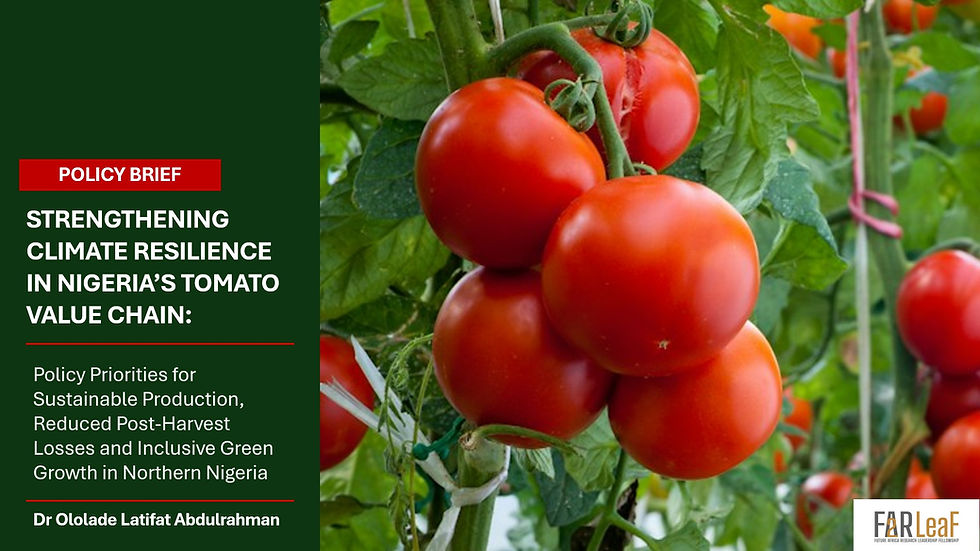
Strengthening Climate Resilience in Nigeria’s Tomato Value Chain: Policy Priorities for Sustainable Production, Reduced Post-Harvest Losses and Inclusive Green Growth in Northern Nigeria
Dr Ololade Latifat Abdulrahman
Investment in Climate-Smart across the tomato Value Chain can significantly reduce post-harvest losses, improve farmers' incomes, strengthen food security, and enhance tomato resilience to climate change in Nigeria.
Prepared from the Capacity Building Workshop on Climate Adaptation for Tomato Value Chain Actors in North-West Nigeria | National Agricultural Extension and Research Liaison Services (NAERLS) Ultra Modern Hall, Ahmadu Bello University, Zaria, June 2026.
Keywords: Climate Change, Climate-Smart Agriculture, Tomato Value Chain, Food Security, Climate Adaptation, Post-Harvest Management, Sustainable Development
Executive Summary
Tomato farming significantly contributes to food security, employment, nutrition and agro-industrial development in Nigeria. However, climate variability, such as erratic rainfall, rising temperatures, prolonged dry spells, flooding, and emerging pests and diseases, is driving down productivity across the entire tomato value chain. The poor rural infrastructure and weak extension coverage, low access to climate information and lack of post-harvest management contribute to significant economic losses and reduce farmer incomes, further exacerbated by these climate-related challenges. Based on the data gathered during the Capacity Building Workshop on Climate Adaptation for Tomato Value Chain Actors in North-West Nigeria, a significant proportion of the volume of tomatoes grown in Nigeria (estimated at 40%–50%) is lost before it reaches the consumer, mainly due to the lack of adequate storage facilities, poor transport, weak market systems, and lack of processing. The need for more sustainable interventions in the tomato value chain was therefore emphasised. When implemented, this can increase the resilience of the value chain through climate-smart agriculture, improved irrigation, weather-informed agriculture, integrated pest management, solar-powered processing technologies, digital market systems, and strengthened institutional partnerships.
This policy brief presents strategic recommendations to strengthen climate resilience through well-coordinated investments in agricultural extension, climate-smart infrastructure, research and innovation, market development, climate information services, and public-private partnerships. Implementing these recommendations will contribute to increased productivity, reduced food losses, improved livelihoods, and sustainable agricultural transformation.
Policy Messages
Integrate climate adaptation into the national and state agricultural policies.
Invest in climate-smart infrastructure, such as irrigation, cold storage, and processing facilities.
Increase the scale of implementing climate-smart extension and digital weather advisory services.
Scale up post-harvest innovations to minimise food loss and add value.
Build partnerships between the government, research institutions, development partners and the private sector.
The Policy Issue, Evidence and Recommendations
Why This Matters
Tomato production is no longer a seasonal farming practice but a risky business due to climate change. Smallholder farmers are exposed to growing risks from changing weather conditions, loss of soil fertility, pests and diseases, and poor infrastructure. These problems affect productivity, reduce household incomes, and pose a serious threat to the nation's food security.
Evidence from the Capacity Building Workshop
Adoption of climate-smart production practices.
Promotion of improved tomato varieties.
Expansion of efficient irrigation technologies.
Integrated pest and disease management.
Farmer access to localised weather forecasts.
Solar drying and value addition technologies.
Improved storage and transportation systems.
Digital market information platforms.
Strengthened farmer cooperatives and institutional partnerships
The workshop identified a number of priority interventions, including:
Climate-Smart Extension through the recruitment and training of extension personnel to support climate-resilient farming practices.
Infrastructure Development by investing in irrigation, rural roads, aggregation centres, cold storage, and processing facilities.
Promote the development and dissemination of drought-, heat-, and disease-resistant, early-maturing tomatoes.
Provision of climate Information Services that strengthen collaboration with NiMet to deliver localised weather forecasts and early warning systems.
Post-Harvest Management practices, including plastic crates, solar dryers, cold storage, and improved transport systems.
Research & Innovation to scale research on climate-resilient tomato varieties and digital agriculture solutions.
Finance & Investment, expanding access to climate finance, agricultural insurance, and concessional credit.
Institutional Collaboration that strengthens partnerships among government, research institutions, development partners, and the private sector.
The Implementation of the recommendation is expected to:
Increase tomato productivity
Reduce post-harvest losses
Improve Farmers income
Enhance food security
Create employment opportunities
Promote climate resilience
Stimulate agro-industrial development
Strengthen sustainable rural livelihoods
Recommendations:
1 | Mainstreaming climate-smart Agriculture (CSA) into Agricultural policies, programmes and budgetary allocations by integrating climate adaptation strategies into National and sub-national development plans |
2 | Expand and adequately strengthen Agricultural Extension and Advisory Services through the provision of continuous training on climate-smart production practices, integrated pest management, water-efficient irrigation technologies, farm business management, and digital agricultural advisory services. |
3 | Investments should focus on climate-resilient infrastructure, such as irrigation schemes, rural feeder roads, aggregation centres, cold storage facilities, climate-smart processing centres, and renewable-energy-powered storage technologies, to reduce production risks and post-harvest losses. |
4 | Strengthen collaboration among relevant institutions, such as the Nigerian Meteorological Agency (NiMet), to provide access to climate information and early warning systems, including localised weather forecasts, seasonal climate outlooks, and early warning information, through digital platforms, mobile applications, radio, and extension networks. |
5 | Policies should encourage the adoption of improved harvesting, handling, storage, transportation, and processing technologies, including plastic harvesting crates, solar dryers, evaporative cooling systems, and solar-powered cold rooms to significantly reduce post-harvest losses. |
6 | Increased investments to support research institutions in developing climate-resilient tomato varieties, sustainable pest and disease management strategies, digital agricultural innovations, and affordable post-harvest technologies. Stronger linkages between research institutions and extension systems should be established to facilitate the rapid dissemination of technology. |
7 | Strengthen financial institutions by improving access to Climate Finance and Agricultural Insurance, developing inclusive financing mechanisms that provide affordable credit, climate adaptation grants, agricultural insurance, and risk-sharing facilities to enable farmers, processors, and agribusinesses to invest in climate-resilient technologies. |
8 | Strengthen Farmer Organisations and Market Systems by improving collective marketing, input procurement, access to finance, market information, contract farming opportunities, and value addition initiatives that enhance competitiveness and bargaining power. |
Conclusion:
Nigeria’s climate is rapidly reshaping the agricultural landscape, with profound implications for the sustainability of the tomato value chain. The evidence generated through the capacity building workshop on Climate Adaptation for Tomato Value Chain Actors in North-West Nigeria demonstrates that climate-related challenges such as erratic rainfall, prolonged droughts, flooding, rising temperature, pest and disease outbreaks, inadequate post-harvest infrastructure, and weak market systems continue to undermine productivity, increase post-harvest losses, and threaten the livelihoods of thousands of smallholder farmers. However, these challenges are surmountable with well-coordinated policy reforms, informed public and private investments, strengthened extension systems and multi-stakeholder partnerships that integrate climate adaptation across the value chain.
Policy brief by Dr Ololade Latifat Abdulrahman