Competing perspectives are shaping climate resilience along Dar es Salaam's Msimbazi River

At first glance, Emmanuel's nursery seems like an unlikely place to begin a story about climate change.
Hidden behind a cluster of modest homes in Ilala District, Dar es Salaam, the nursery is a mosaic of green. Rows of ornamental palms stretch towards the morning sun, while flowering shrubs add splashes of colour between carefully arranged seedlings. Trees stand beside fruit saplings, medicinal plants, and climbing vines, each growing in recycled black nursery bags filled with rich, dark soil. Butterflies drift lazily from flower to flower, and the scent of damp earth hangs in the air after an early morning watering. The constant sounds of traffic from the nearby city fade beneath the rustle of leaves and the songs of birds that have found refuge among the trees.

It is difficult to imagine that this peaceful corner of the city lies within one of Dar es Salaam's most flood-prone landscapes.
For Emmanuel, the nursery is much more than a place where plants are grown and sold. It is where livelihood, environmental stewardship, and hope come together. Each morning, he carefully inspects hundreds of seedlings, knowing that every plant represents months of patience and care. Some will shade family homes, while others will be planted in schools, churches, offices, hotels, and public spaces. Many will eventually line roadsides and riverbanks, helping to stabilise soils, improve biodiversity, and reduce the impacts of heavy rainfall. He and his friend started the nursery as a response to unemployment. Like many young people in Dar es Salaam, they struggled to find stable work and turned their knowledge of plant cultivation into a source of income. What started as a small business has grown into a thriving enterprise that supplies plants across the city while contributing to landscape restoration and strengthening the resilience of neighbourhoods increasingly affected by climate change. As Emmanuel gently brushes soil from the leaves of a young palm, he pauses to explain why he enjoys this work.
"Most people come here because they want a beautiful garden," he says with a smile. "They leave with something that will last much longer. A tree provides shade, improves air quality, attracts birds, and helps protect the land. It grows with the community."
His words capture a simple but profound idea. The seedlings surrounding us are not merely products waiting to be sold. They are living investments in a city's future, learning to adapt to a changing climate. Every tree planted along a riverbank strengthens fragile soil. Every ornamental tree planted in a school compound cools the surrounding environment. Every fruit tree planted beside a home contributes to food security, biodiversity, and household livelihoods. Individually, these actions may appear small. Together, they are gradually reshaping the urban landscape.

Standing among the rows of vibrant seedlings, it is easy to forget why these trees matter so much. The nursery feels calm, almost detached from the pressures of the city beyond its boundaries. Yet Emmanuel knows that only a few minutes' walk away, another landscape tells a very different story. There, the river bears the marks of intense human activity, where livelihoods and environmental change have reshaped both the riverbanks and the surrounding landscape.
"Come," Emmanuel says, gesturing towards a narrow footpath leading out of the nursery. "If you want to understand why we grow these trees, you first need to see the river."
Leaving Emmanuel's nursery behind, we followed a narrow footpath towards the banks of the Msimbazi River. The change in landscape was immediate. The beauty of the nursery gave way to an open stretch of river where groups of young men stood knee-deep in the water, shovelling sand into waiting trucks. Curious, we stopped to ask what they were doing.

One of the young men rested his shovel against his shoulder before answering.
"This is river training," he said. "We remove the sand so the river can flow better, and we sell it to earn a living."
For him and the others working alongside him, the river was more than a waterway. It was a workplace. The sand supplied Dar es Salaam's growing construction industry, while the income supported families in a city where secure employment is difficult to find.
The following day, we returned to the river and continued walking downstream. As we made our way along the riverbank, the sky darkened. Within minutes, heavy rain swept across the river valley. We watched as the calm channel transformed. The water level rose rapidly, carrying muddy water, branches, and debris downstream. Low-lying sections of the riverbank disappeared beneath the rising water, offering a stark reminder of how quickly flooding can develop in the Msimbazi catchment.
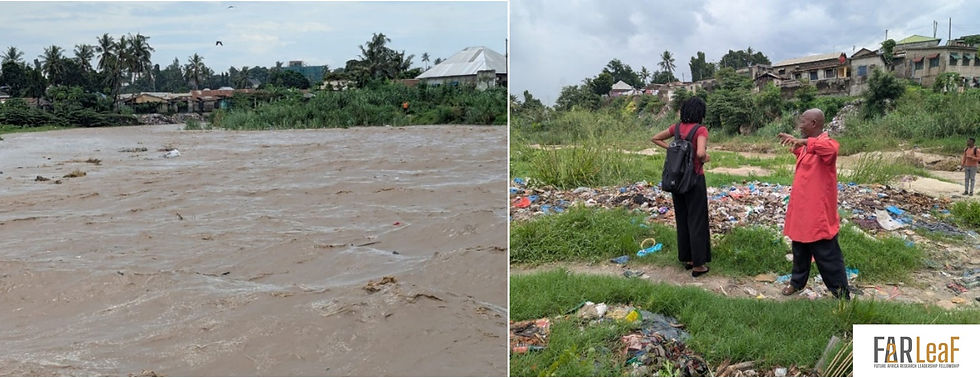
Nearby, a member of the Mtaa neighbourhood committee watched the river with growing concern. Shaking his head, he pointed towards the areas where sand was being extracted.
"These activities are making the flooding worse," he said. "The government should stop them before the river becomes even more dangerous."
When we asked him about the solid waste scattered along the riverbanks, he replied, "Solid waste is one of the city's major sanitation problems. It blocks drainage channels and contributes to flooding". The comment stayed with us. Later, when we spoke to the Ilala Municipal Environmental Officer, he offered a different interpretation.
"This should not simply be called sand mining," he explained. "It is river training. The intention is to improve the river's capacity to convey water and reduce flood risk."
Standing beside the swollen river, it became clear that the Msimbazi carries more than floodwater. It also carries competing ideas about how the river should be managed. For the young men working on the river, it provides a livelihood. For some residents, the same activity contributes to erosion and increases flood risk. Municipal authorities, however, regard it as part of river management. Together, these perspectives reveal the difficult balance between sustaining livelihoods, protecting ecosystems, and reducing flood risk in one of Africa's fastest-growing cities. The challenge is not simply deciding who is right, but finding ways to ensure that the river continues to support both people and nature in a rapidly changing city.

Our conversations did not end at the river. To better understand how communities are responding to flooding, my field assistant, Tayson Temba, and I met with members of the Environmental Committee in Tabata Ward, Ilala District. Their experiences revealed another dimension of climate resilience, rooted in collective action but constrained by the realities of rapid urbanisation.
The committee members explained that residents have adopted a range of Nature-based Solutions to reduce flood risks within their neighbourhoods. Households are encouraged to plant trees around their homes to improve shade, stabilise soils, and enhance the local environment. Wetlands are protected wherever possible, while reeds are planted along vulnerable sections of riverbanks to reduce erosion. These activities form part of broader community efforts to strengthen resilience against increasingly frequent floods.
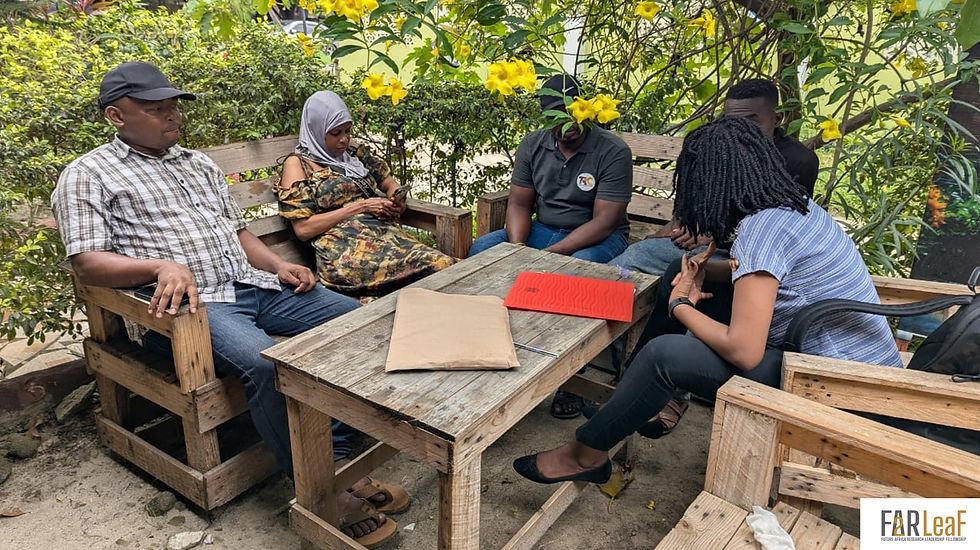
Regular environmental campaigns complement nature-based Solutions. Committee members organise awareness activities to discourage residents from dumping solid waste into rivers and drainage channels. On the last Saturday of every month, community members participate in neighbourhood clean-up campaigns to remove waste from drains and public spaces. Tree-planting activities are also carried out in collaboration with government institutions, civil society organisations, and other partners.
Despite these efforts, the committee members acknowledged that the challenges continue to grow.
"The river continues to expand," one committee member explained. "Our efforts are becoming increasingly difficult because the problem is growing faster than our interventions."
A major concern raised during our discussion was the limited space available for implementing Nature-based Solutions on a larger scale. Much of the land surrounding the river is privately owned, and many landowners prioritise building over preserving green spaces or restoring wetlands.
The committee members also reflected on the broader pattern of urban development in Dar es Salaam. According to them, more than 70% of the city consists of unplanned settlements. Many low-income households settle in these areas because housing is affordable and they are close to the city centre, where employment opportunities are concentrated.
While they viewed community participation as essential, they argued that tree planting and neighbourhood clean-up campaigns alone cannot solve the city's flood challenges. They emphasised the urgent need to regularise and upgrade unplanned settlements through improved urban planning and infrastructure.
"We call these areas unplanned settlements," one committee member reflected. "Yet the government continues to provide public services there. We have made mistakes in the past, and we need to learn from those mistakes so that we do not continue repeating them."
Their reflections reinforced what we had learned along the Msimbazi River. Community-led Nature-based Solutions are making valuable contributions to flood resilience. Still, lasting progress will require better urban planning, stronger institutions, and sufficient space for nature to thrive within a rapidly growing city.
Article on field visit submitted by Dr Agnes Kapinga.