Women in science leadership
- Mar 9
- 3 min read

On International Women’s Day 2026, the InterAcademy Partnership (IAP) launched a month-long global campaign, “From Presence to Power”, celebrating women shaping science across our regions and reinforcing the institutional changes needed to achieve gender equality in scientific organisations. This year’s campaign builds directly on the newly released global study: Towards gender equality in scientific organisations: assessment and recommendations, published in February 2026 by the International Science Council, the InterAcademy Partnership and the Standing Committee for Gender Equality in Science:
Barriers to progression or recognition within scientific organisations were reported frequently, particularly by women. Women (31%) were approximately three times more likely than men (10%) to report such barriers. This pattern was consistent across disciplines and organisation types. Reported barriers were lowest in the health, medical, agricultural and veterinary sciences (14%), moderate in the natural and engineering sciences (21%), and highest in the social sciences and humanities (30%). Across all fields and organisational contexts – including international scientific unions, national academies and national professional societies – women were consistently more likely than men to report barriers to participation, progression or recognition, indicating a persistent gender gap after initial access. (ISC, 2026:63)
Professor Stephanie Burton (co-President of the IAP) is the Programme Director of the Future Africa Research Leadership Fellowship (FAR-LeaF) – a programme which focuses on future-oriented science leadership and human capital development for early-career researchers. As part of the FAR-LeaF programme values, leadership encompasses the necessary changes in the research ecosystem. As such, the programme strongly focuses on research development and management, career development, establishing interdisciplinary relationships, building networks, and acquiring leadership competencies.
According to Professor Burton, “moving from presence to power means ensuring that women are not only part of scientific institutions but are also shaping their direction. Leadership diversity strengthens science and makes our organisations more effective and more inclusive.”
The FAR-LeaF programme supports institutional capacity building through engagement with the host institution’s regional areas of interest. The research topic is integrated into a broader strategy for leadership development through practical experience, exposure to leadership opportunities, mentoring, and a balanced career development plan.
The programme prioritises female researchers and currently supports 14 female research fellows from eight African countries in research projects relevant to national and regional challenges through transdisciplinary research methods. Cohort I (2022-2024) supported ten female researchers from seven African countries.


FAR-LeaF II (2025-2027)
The Future Africa Research Leadership Fellowship (FAR-LeaF) is a two-year research-oriented fellowship programme supported by the Carnegie Corporation of New York and hosted by Future Africa. The programme focuses on future-looking science leadership and developing the next generation of African scientists and academics.
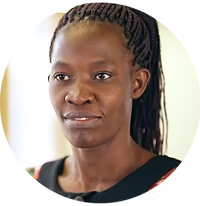



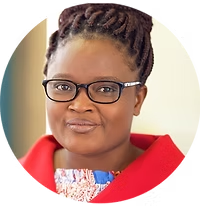
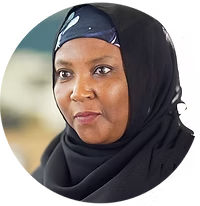
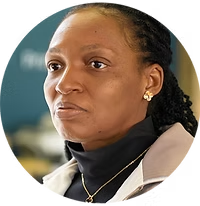



FAR-LeaF I (2022-2024)
Professor Stephanie Burton has a strong interest in research capacity building and research ethics and integrity. She is recognised for her leadership and expertise in research strategy, research management and development, postgraduate supervision, innovation activities, open science and science communication initiatives, and internationalisation programmes. She is currently coordinating national projects on mentoring and capacity development for early-career academics. She is the Chairperson of the Universities South Africa (USAf) Community of Practice in Postgraduate Education and Scholarship, and serves on several other national and international bodies related to research and doctoral training.
Professor Stephanie Burton is a Professor in Biochemistry and a Senior Professor at Future Africa at the University of Pretoria (UP). She is the former Vice-Principal for Research and Postgraduate Education at UP and the Programme Leader for the Future Africa Research Leadership Fellowship programme. She is a Fellow of the Royal Society of South Africa (RSSA) and has served as the President of the RSSAf and interim President of the Academy of Science of South Africa (ASSAf). She is a Research Fellow for Universities South Africa (USAf) and Co-President of the Inter-Academy Partnership (IAP).

International Science Council, InterAcademy Partnership and Standing Committee for Gender Equality in Science (February 2026) Towards gender equality in scientific Organizations: assessment and recommendations. DOI: 10.24948/2026.03